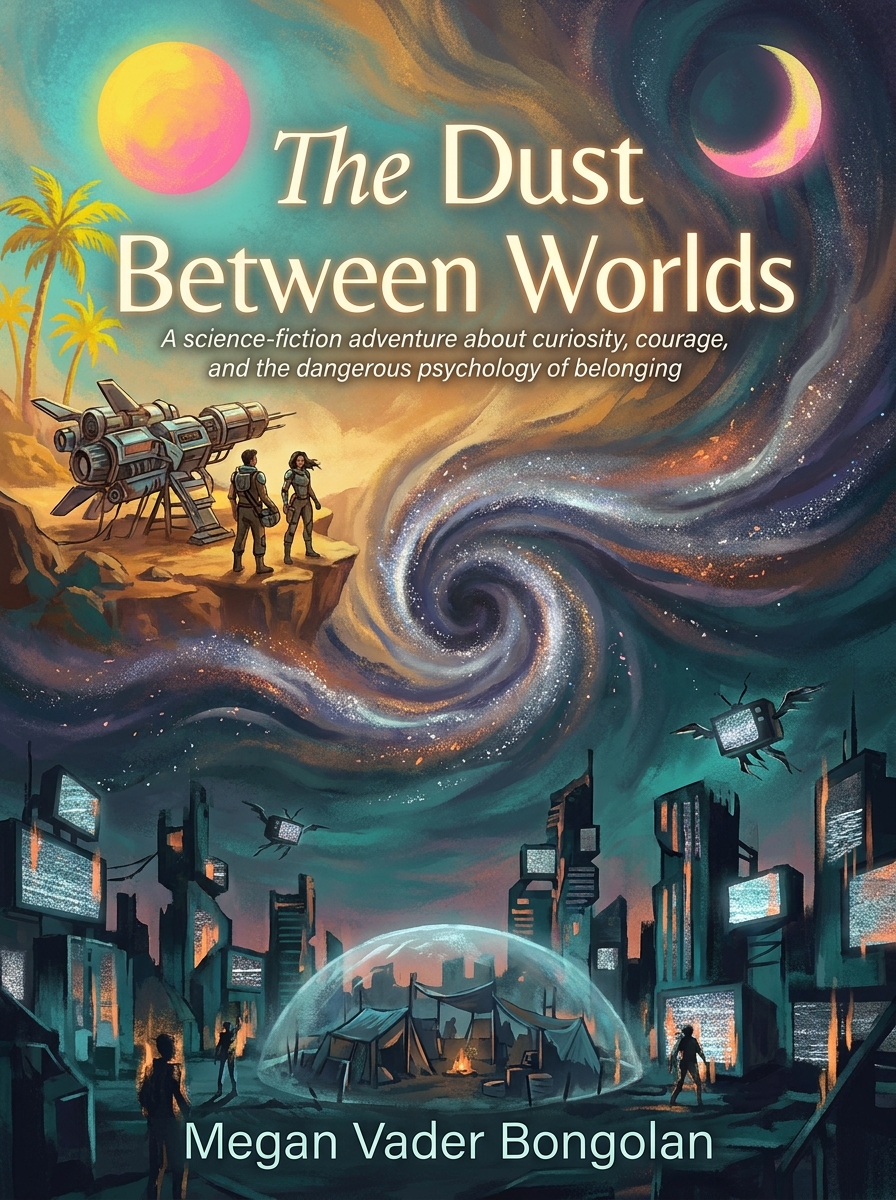
The warning bell began before the sun rose.
Reno woke with one hand already reaching for the instrument panel, his fingers striking the metal housing hard enough to split the skin beside his thumb. The observation station trembled beneath him. Somewhere below the floor, a pump coughed, recovered, and coughed again. The bell continued its thin, urgent ringing through the sleeping quarters, through the storage room, through the narrow passage where yellow dust had gathered in the seams.
“Atmospheric alarm,” Raeh said from the doorway.
She was barefoot, her dark hair tied in a loose knot, one shoulder of her work shirt hanging open. Behind her, the station’s eastern windows glowed with the first light of Serapho’s morning—a bruised wash of pink beneath a rising yellow sun.
Reno stared at the panel. “It’s not scheduled.”
“Nothing interesting ever is.”
He shoved himself out of the bunk and pulled on his boots. “That’s not comforting.”
“It wasn’t meant to be.”
They hurried through the station’s central chamber, past the water recycler and the sleeping racks used by visiting technicians. The alarm’s rhythm changed as Reno keyed in the override. Three short tones. A pause. Three more.
Raeh leaned over the console beside him. “Outer-atmosphere sensor?”
“Sensor four.”
“That one lies.”
“It drifts. It doesn’t lie.”
“It told us the western cliffs were flooding last month.”
“The cliffs were flooding.”
“Because I opened the rain gates.”
Reno glanced at her. “You opened them without authorization.”
“And the cliffs survived.”
“The station nearly didn’t.”
Raeh smiled faintly. “You’re welcome.”
The alarm stopped. In its place came a low mechanical hum as the station’s instruments turned toward the eastern sky. Beyond the thick windows, Serapho unfolded beneath them in bands of impossible color. The ocean below was turquoise, bright as polished glass, lifting and falling against black-gold cliffs. Waterfalls spilled from the highlands in long white ribbons, their spray catching the dawn until the air seemed filled with floating shards of pearl. Yellow palms bent along the coast, their leaves shining like beaten metal.
Farther inland, the lushness ended abruptly.
The green valleys narrowed into ocher plains, then into the Dry Lands, where the earth rose in jagged shelves and cracked basins. The Dry Men lived there in stone settlements built low against the heat. Their skin, yellowed and ridged like weathered rock, made them look carved from the planet itself. They tended the long-range instruments, mapped the storms, and sent data back to the coastal stations with a patience Reno privately considered more reliable than most machines.
The observation station stood at the edge of all of it, on a rocky shelf above the water. It was officially called the Seraphan Eastern Atmospheric Observatory, though the workers called it the Yellow Edge. There was no city traffic here, no card tables, no singing from the market towers, no hot cups of Buttered Milk bubbling with sugar and vitamins. There was only the sea, the cliffs, the sun, and the constant dry whisper of wind rubbing dust against the station walls.
Reno magnified the sensor display. A field of numbers appeared, then collapsed into a rolling map.
“Sensor four is reading a particulate density spike,” he said.
Raeh dragged a stool beneath her and sat. “How large?”
“Sixteen percent above the seasonal average.”
“That’s not a spike. That’s a disagreement.”
“Thirty-two percent.”
Her smile vanished.
Reno adjusted the filter. The map showed the upper atmosphere in layers: Serapho’s warm lower air, the colder blue band above it, and the dark region where the planet’s protective shield began to disperse incoming matter. Normally, Hackesh Dust appeared as a faint gray veil beyond the shield, scattered harmlessly by the planet’s magnetic lattice. The dust was dangerous in concentration. Each grain was smaller than a grain of sand, but volatile enough to flash into fire when compressed or struck by charged particles. A thick cloud could burn through satellites, rupture station hulls, or rain lethal heat into the atmosphere.
Serapho had shielded itself from Hackesh Dust for generations. At the major space stations near the water, shield crews watched the sky and adjusted the planetary barrier by degrees. The system was so old and so well understood that most people treated it like gravity.
Reno did not.
He enlarged the eastern horizon. “It’s moving against the predicted current.”
Raeh leaned forward until her face was inches from the screen. “How far?”
“Two hundred and eighty thousand measures from the shield.”
“That’s outside the warning boundary.”
“Barely.”
“Barely is still outside.”
“That’s what the warning boundary is for.”
Raeh looked toward the windows. The sun had cleared the ocean now, a great yellow-pink disk bleeding color across the water. Its light struck the station’s white walls and turned them the shade of old bone.
“When did it change direction?” she asked.
Reno searched the recorded data. “Six hours ago. Maybe seven.”
“Why wasn’t the city notified?”
“Because the system classified it as a temporary shear.”
“Did it?”
He turned toward her. “The system did.”
Raeh took the data slate from his hand. She scrolled quickly, then stopped. “Look at the pressure line.”
“I am looking at it.”
“No, you’re looking at the average.” She tapped the screen. “Here. Beneath the drift.”
Reno bent closer.
The pressure line was almost invisible under the broader atmospheric readings, a series of tiny fluctuations repeating at irregular intervals. He isolated the pattern and fed it through the station’s comparison archive. The machine searched. For several seconds, only the hum of the pumps filled the room.
Then the display changed.
A red thread appeared beneath the map, climbing steadily from the outer dark toward Serapho.
Raeh whispered, “It’s pulsing.”
Reno’s mouth went dry. “Dust clouds don’t pulse.”
“This one does.”