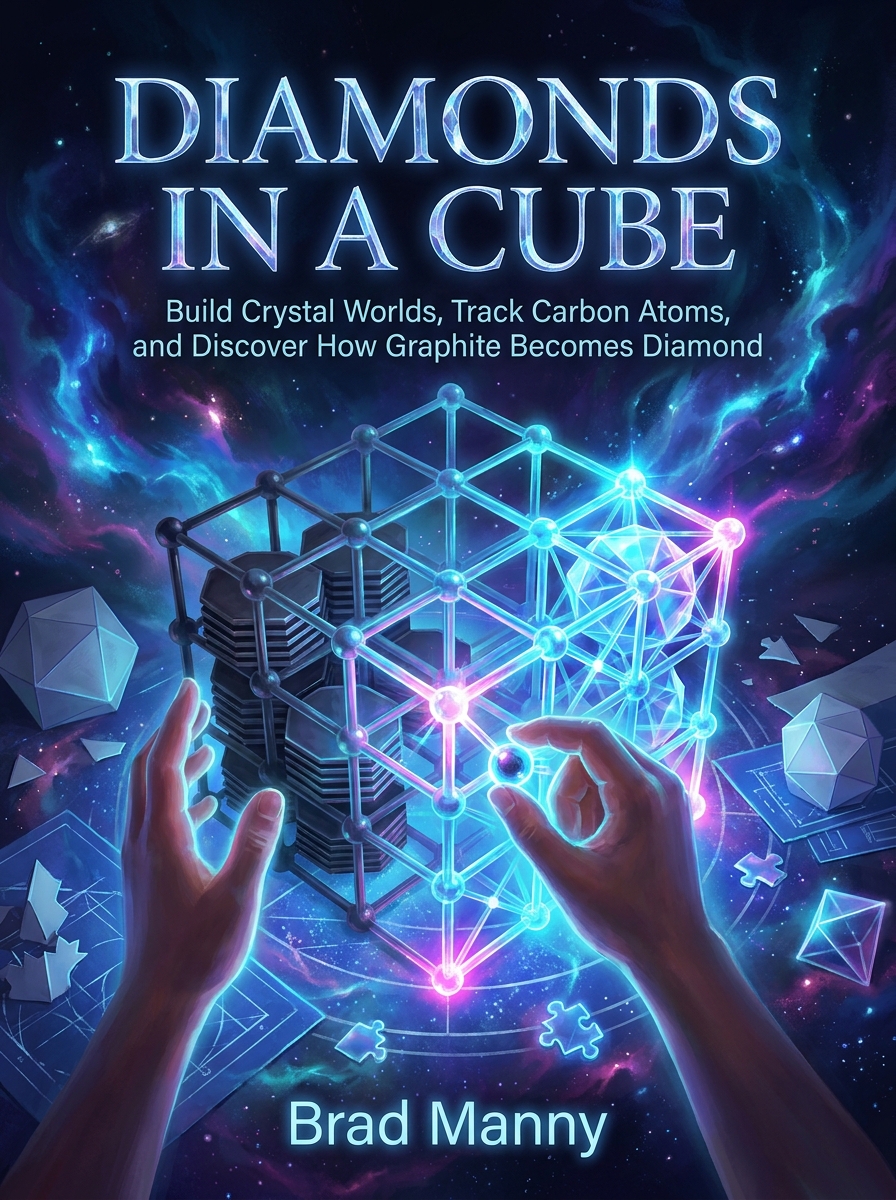
The cube arrived during a thunderstorm.
Maya heard the front door bang downstairs, followed by her father calling, “Package for the scientist!” She hurried into the kitchen wearing one sock and carrying a pencil behind her ear. Rain rattled against the windows. On the lab table—a rescued desk pushed beneath the brightest lamp—sat a wooden crate no larger than a loaf of bread.
It had no return address. No shipping label. Only a black symbol burned into the lid: a tiny cube with one corner shining like a star.
Maya touched the latch. Cold metal pressed into her fingertip.
“Should I get Mom?” her brother Theo asked from the doorway.
“You’re the one who said you weren’t scared of mysterious packages.”
“I said that before it became mysterious.”
The latch clicked open. Inside, wrapped in dark blue cloth, lay a transparent cube. It looked like glass, but it held a pale silver glow, as if moonlight had been trapped inside. Along one face, someone had printed a message:
*ONE ELEMENT. TWO MATERIALS. BUILD THE SHAPE. SOLVE THE CHANGE.*
Beneath the words rested a folded card. Maya opened it carefully. A second message waited inside.
Your first challenge: explain how the same kind of atom can become soft graphite or brilliant diamond. Begin with the cube.
Thunder rolled overhead. The glowing cube gave a faint, chiming vibration.
Theo leaned closer. “What’s an atom?”
Maya glanced at the pencil behind her ear. “Good question,” she said. “Let’s find out before the cube does something stranger.”
*
Maya spread supplies across the table: drinking straws, wooden craft sticks, small lumps of reusable clay, scissors, a ruler, and a sheet of graph paper. She added a pencil, then paused and pulled it back. The pencil’s dark wooden body looked ordinary, but its center contained the first clue.
An atom is a tiny piece of matter—far too small to see with your eyes. Everything around them was made from atoms: the table, the rain, the pencil, even the air filling Theo’s lungs. Atoms themselves contain smaller parts, but for this investigation Maya needed to imagine each one as a tiny building piece, like a bead that could connect with other beads.
“Are all atoms the same?” Theo asked.
“No. Different kinds are called elements,” Maya said, writing the word on the graph paper. “Gold is one element. Oxygen is another. Carbon is another.”
Carbon appeared in charcoal, soot, living things, and the dark material inside pencils. A material can contain carbon mixed with other elements, but graphite—the pencil material that leaves a gray streak—consists of carbon atoms arranged in a particular way. Diamond is also carbon. That was the mystery: not a diamond atom and a graphite atom, but the same element wearing two completely different arrangements.
Maya dragged the pencil across the paper. A soft line appeared, shiny at the edges. “Graphite writes because its carbon atoms are arranged in layers,” she said. “The layers can slide over one another and rub off.”
Theo picked up the glowing cube. “And diamond?”
“Let’s not guess yet.” Maya pointed to the supplies. “We need to build matter before we explain it.”
*
They began with four straws. Maya cut them to equal lengths, checking each one against the ruler. She joined the ends with clay until the straws formed a square, but it wobbled like a window in a loose frame.
“A square is flat,” she said. “A cube has depth. We need another square.”
Theo built the second frame, pressing clay into the straw ends with his thumbs. When both squares were ready, they connected matching corners with four craft sticks. The shape rose from the table: a small open box with eight corners and twelve edges.
Maya held it beneath the lamp. “This is a model of a cube. It isn’t the real thing, of course. Atoms aren’t hollow straw boxes. Models leave out some details so we can notice one important idea.”
She placed a clay bead at every corner. “These are our pretend atoms.”
Theo poked one. It sagged sideways.
“Corners aren’t the only possible positions,” Maya said. “Imagine atoms arranged throughout a repeating pattern, like tiles across a floor or bricks in a wall. A crystal is a solid whose atoms follow an orderly, repeating arrangement.”
“Like a pattern that keeps going?”
“Exactly. If our cube were one tiny window into a much larger pattern, each corner would connect to neighboring cubes beyond what we can see.”
Theo looked through the open center. The rain streaked the window behind it into silver lines. “So crystals are organized.”
“Organized enough to make rules,” Maya replied. “The distances and directions between atoms affect how the whole material behaves.”
She set a second clay bead inside the cube. It dropped through the open frame and rolled under the table.
Theo groaned. “Our atom escaped.”
“Then our first model has already taught us something,” Maya said. “A cube made only of edges does not show everything happening inside.”
*
Maya unfolded the graph paper and drew a cube in perspective, using solid lines for the edges she could see and faint lines for the hidden ones. Then she marked each corner with a dark dot. The drawing looked simple, but when she added another cube beside it, the corners began to overlap.
“Look,” she said. “One corner can belong to more than one cube. That is why scientists have to be precise when they describe a crystal structure. They ask where the atoms are, how far apart they sit, and which atoms are connected.”
She and Theo rebuilt the model with clay beads pressed into a three-dimensional pattern. Instead of placing beads only at the corners, they stretched rubber bands across the cube and clipped beads where the bands crossed. The shape became crowded, less like an empty box and more like a tiny room filled with invisible scaffolding.