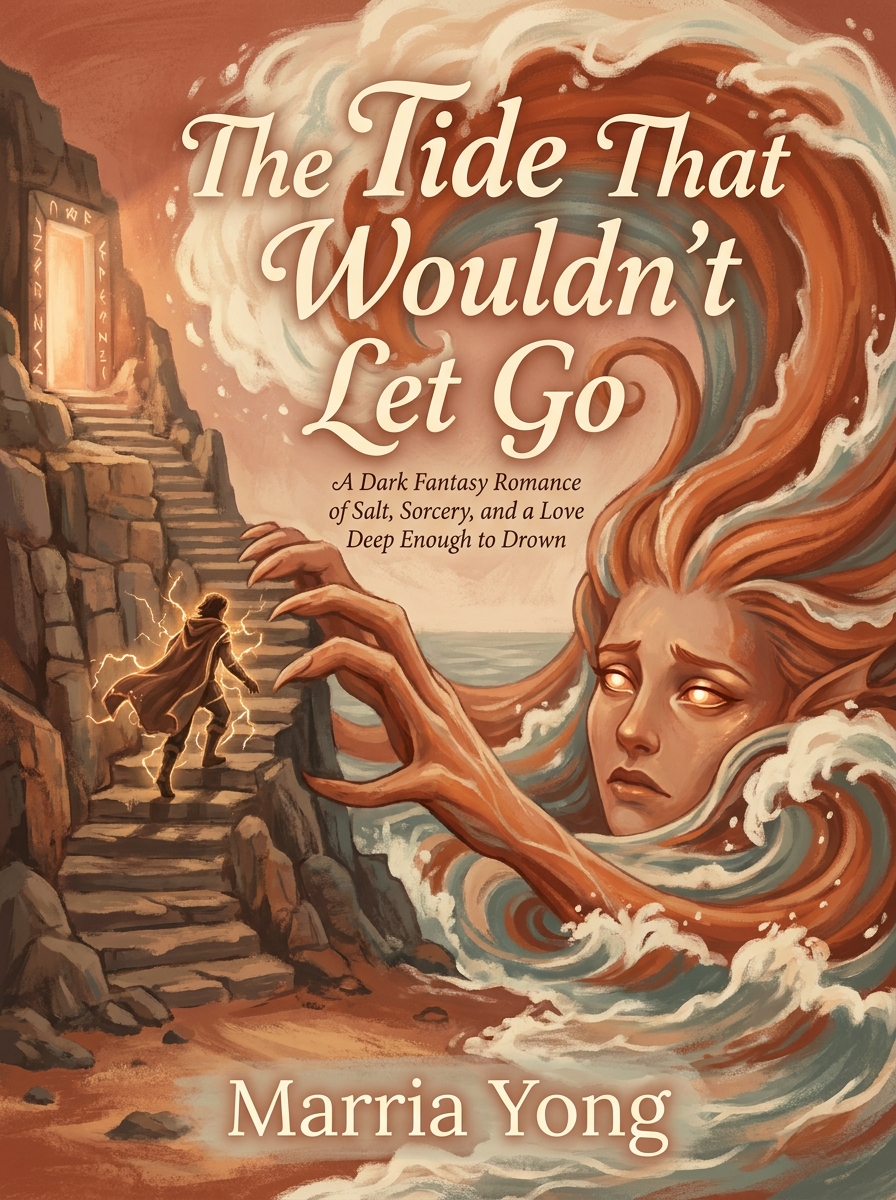
The storm broke the Morrowglass against Blackwake Reef at midnight.
Elias Vane heard the hull split before he saw the rock—a deep wooden crack beneath the thunder, followed by the violent lurch of the deck. Lanterns swung from their hooks, smearing yellow across the rain. Somewhere forward, a sailor screamed, and the sea swallowed him before the sound had finished.
Elias seized the mast with one hand and the iron diving bell with the other. The bell was no larger than a child’s skull, green with age, its bronze mouth sealed by a crust of black salt. A chain ran through its handle and around his wrist. In the captain’s cabin, the dead man’s map had marked the wreck below the reef with a single line of red ink: The drowned king’s seal lies where the bell still rings.
“Leave it!” shouted Bram, the first mate. He clung to the rail, blood bright on his cheek. “Vane, cut the chain!”
“My brother owed for it,” Elias shouted back.
Lightning opened the sky. For an instant, the reef stood white and jagged through the rain, and below it the sea boiled around the broken ribs of another ship. The Morrowglass shuddered again. Elias looked once at the bell, once at the black water, and saw his brother’s face as clearly as if Jonah stood beside him—smiling through a split lip, promising he would come home before winter.
Then the mast tore free.
Elias cut the line from his waist, tucked the bell against his ribs, and jumped.
The sea struck like stone. Cold punched the breath from Elias’s lungs and drove him downward through green-black darkness. Above him, the storm became a muffled fury, thunder reduced to dull blows against the water. He kicked hard, but the bell dragged at his arm, its chain biting through his glove.
The wreck waited beneath him.
It had once been a warship, broad in the beam and proud in its ruin. Its masts lay broken across the seabed, draped in weed that waved though there was no current. Fish fled from Elias’s light, their scales flashing like coins. The map had promised a cargo hold beneath the stern, but the stern had folded inward, crushing the entrance beneath beams and cannon mouths.
His lungs began to burn.
Elias wedged his fingers into a split in the hull and pulled himself through. Wood scraped his shoulders. Something soft brushed his cheek, and he nearly cried out before recognizing the pale fingers of drowned sailors tangled in the beams. Their mouths gaped toward him, packed with sand.
The bell bumped against a rib of timber.
Once.
The sound did not travel through water. It traveled through bone.
Elias froze. Far below, where the wreck’s shadow thickened into a pit, something answered with a slow metallic groan.
He forced himself onward.
A narrow passage opened into the hold. Crates had burst apart, spilling silver cups, rusted weapons, and the bleached skulls of men who had died chained together. At the center rested a stone coffer veined with red, its lid carved with a crowned figure whose eyes had been gouged away.
Elias reached for it, but the bell jerked violently against his wrist.
The chain pulled downward.
Not snagged. Pulled.
He twisted, kicking toward the broken hull, yet the darkness below had taken hold of the bell. His glove tore. The metal handle cut into his palm. Through the water came another ring, louder now, and the carved king on the coffer seemed to turn his faceless head.
Elias thought of Jonah’s debt: the gambling knives, the harbor enforcers, the woman who had come to their rented room with a ledger and two men behind her. Jonah had promised the bell would buy their freedom. Jonah had drowned before he could steal it, leaving Elias with the debt, the threats, and a mother who now slept with a chair beneath the door handle.
He wrapped both hands around the chain.
“Not yours,” he mouthed at the dark.
The dark closed around his ankle.
A hand—long-fingered, cold as winter iron—clamped above his boot.
Elias kicked. His heel struck something smooth. The grip tightened until pain flashed white up his leg. Silt burst from the seabed, veiling the hold, and through it moved a shape far too large to be a man. Ribs rose from the murk like the arches of a cathedral. Beneath them, a single eye opened, red and lidless.
His lungs convulsed.
He tore at the hand, but its nails had pierced leather and skin. Blood feathered into the water. The bell rang again, and the ancient eye turned toward the sound.
Elias released the chain.
The bell dropped into the darkness.
For one heartbeat, the hand released him.
Then the wreck screamed.
Timbers buckled. A force like a giant breath blew through the hold, flinging Elias upward. He struck the ceiling, spun, and lost the light from his belt. The sea became a blind, crushing maze. His chest clenched. He tried to swim, but his injured ankle dragged behind him, numb and useless.
Something brushed his back.
He saw Jonah again, not smiling this time. His brother stood at the bottom of the sea with a rope around his throat, pointing upward. You said you’d pay it.
Elias kicked toward the faint gray shimmer above. His vision narrowed. The storm’s light trembled beyond the wreckage, impossibly distant. His mouth opened, and the sea rushed in.
A voice whispered beside his ear.
“Elias.”
He stopped fighting.
The voice was a woman’s, soft as silk drawn across a blade. It curled through the water and found the place where his brother’s name had been buried. Elias turned his head, though every instinct screamed at him to climb.
A face hovered inches away.
She had skin pale as moonlit surf and hair streaming around her in long black ribbons. Her eyes were silver—not gray, not blue, but bright metal reflecting a fire no human could see. A thin scar crossed one cheek. Beneath the waist, her body vanished into a dark, powerful tail that coiled through the wreckage.
Her fingers closed around his jaw.
“You came back,” she whispered.
Elias tried to answer. Bubbles escaped him.