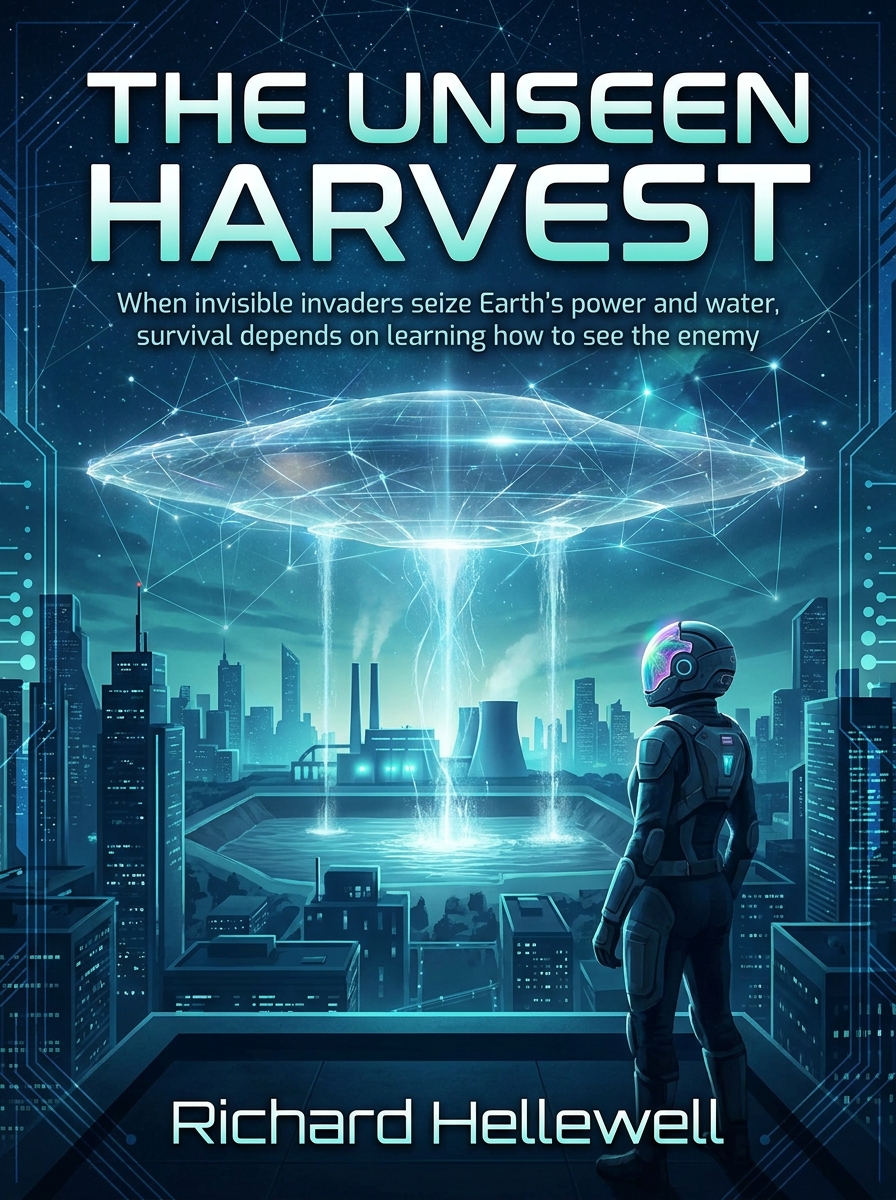
Mara Voss woke to silence.
Not the ordinary silence of her apartment at three in the morning—the refrigerator’s low hum, pipes ticking behind the walls, traffic whispering six floors below—but a silence so complete it seemed to press against her eardrums. The red digits on her bedside clock had vanished. Somewhere in the dark, a fan wound down with a soft mechanical sigh.
She lay still, listening.
A car horn blared on the avenue, stopped abruptly, and left the city mute again. Mara reached for her phone. Its screen remained black beneath her fingers. She tapped the power button twice, then held it down, watching her own pale reflection emerge in the glass.
Outside, New Carthage had become a dead shape under the moon. Towers stood without windows, the streets below reduced to faint silver lines. No aircraft crossed the sky. No warning sirens began. Even the red obstruction lights on the communications spire across the river had gone dark.
Then something moved across her window.
It was not a shadow. Shadows belonged to objects, and there was nothing between her and the glass except the night. This was a ripple, a trembling distortion that traveled from the upper left corner to the lower right, bending the moonlight as if an invisible hand had dragged its fingers through water.
Mara’s breath caught.
The ripple paused over the river. For one instant, a shape hung there—long, narrow, and impossibly smooth. A faint violet shimmer traced its edge, revealing a curved surface larger than a commuter train. Then the light slipped away, and the thing vanished.
Mara was out of bed before she knew she had moved.
She crossed the apartment barefoot, knocking a chair against the kitchen counter. The impact sounded enormous in the dark. Her emergency lantern sat beneath the sink, beside bottled water and a medical kit she had assembled after the Cascadia quakes, but when she twisted its switch, nothing happened.
“Come on,” she whispered.
The lantern stayed dead.
At the window, she pressed both hands to the cold glass. Across the river, the old hydroelectric station crouched beneath its concrete dam, its floodlights extinguished. The reservoir beyond it reflected a perfect black sky. A tremor shivered through the floor, so faint she might have mistaken it for a passing truck—except every vehicle on the avenue had stopped.
Her phone flickered once.
A single notification appeared without a signal bar.
NATIONAL GRID FAILURE—REMAIN INDOORS.
The message vanished before she could touch it.
Mara grabbed her coat and ran for the hallway. Doors opened along the corridor as neighbors stepped out, murmuring into dead phones. Someone’s child began to cry. On the stairwell below, a man shouted that the elevators had trapped people between floors.
“Stay inside!” Mara called, though she had no idea whether the warning came from the government or from whatever had written it.
On the fourth-floor landing, a woman seized her sleeve. “Dr. Voss, what’s happening?”
Mara looked past her to the black windows at the end of the hall. A new shimmer drifted across them, wide enough to cover the entire building, and every pane bowed inward at once.
“I don’t know,” Mara said.
The glass made a sound like ice breaking.
In the operations room beneath the North American Grid Authority, every screen went black within eleven seconds.
Director Elias Chen watched the failure begin in the western sector. Oregon dropped first, followed by northern California, Nevada, and Utah. The map painted itself red as substations disappeared from the network, but the losses did not cascade as they should have. They arrived in clean, deliberate clusters.
“Is this a cyberattack?” someone asked.
Chen stood behind the analysts, one hand braced on a console. “Show me the physical status.”
A technician pulled up the backup feed. Hoover Dam was offline. So were the Bonneville turbines, the Glen Canyon generators, and the pumping stations that carried water toward three states. Every sensor at every site reported the same condition: power present, controls unresponsive, no heat signatures, no intruders.
Then the eastern grid began to fall.
In London, the lights vanished around the Thames Barrier. In São Paulo, the hydroelectric network failed in a ring. Outside Cairo, the Nile pumping stations stopped together, leaving their warning beacons blinking for exactly four seconds before darkness swallowed them. In the Gobi, remote solar fields went quiet beneath a sky crowded with stars.
The pattern crossed oceans faster than any aircraft.
Chen leaned toward the main display. “What am I looking at?”
“No telemetry,” the technician said. “The satellites are dropping too.”
A second analyst brought up emergency communications. The map filled with blinking points, then shed them one by one. Hospitals switched to generators. Airports lost navigation. Nuclear facilities reported isolation. Dams locked their spillway controls, not from damage but from commands issued by systems no human operator could access.
On a small monitor, a security camera from the Yards Reservoir stuttered into life.
The image showed moonlit water and a maintenance road. Something passed above the reservoir, bending the stars. For less than a second, pale lines appeared in the air: a vast oval hull, ribbed underneath, its surface shifting like oil over glass.
The camera went black.
“Enhance that,” Chen said.
“We can’t.”
“Why not?”
“Because the camera isn’t transmitting anymore.”
A warning siren sounded in the operations room. Not an external alarm—a local one, triggered by the building’s pressure sensors. The floor trembled beneath their feet.
On the display, every remaining grid marker disappeared at once.
For a moment, the world’s power network existed only as a blank, dark map.
Then the water systems began to fail.
Mara reached the roof through a door that should have been locked.