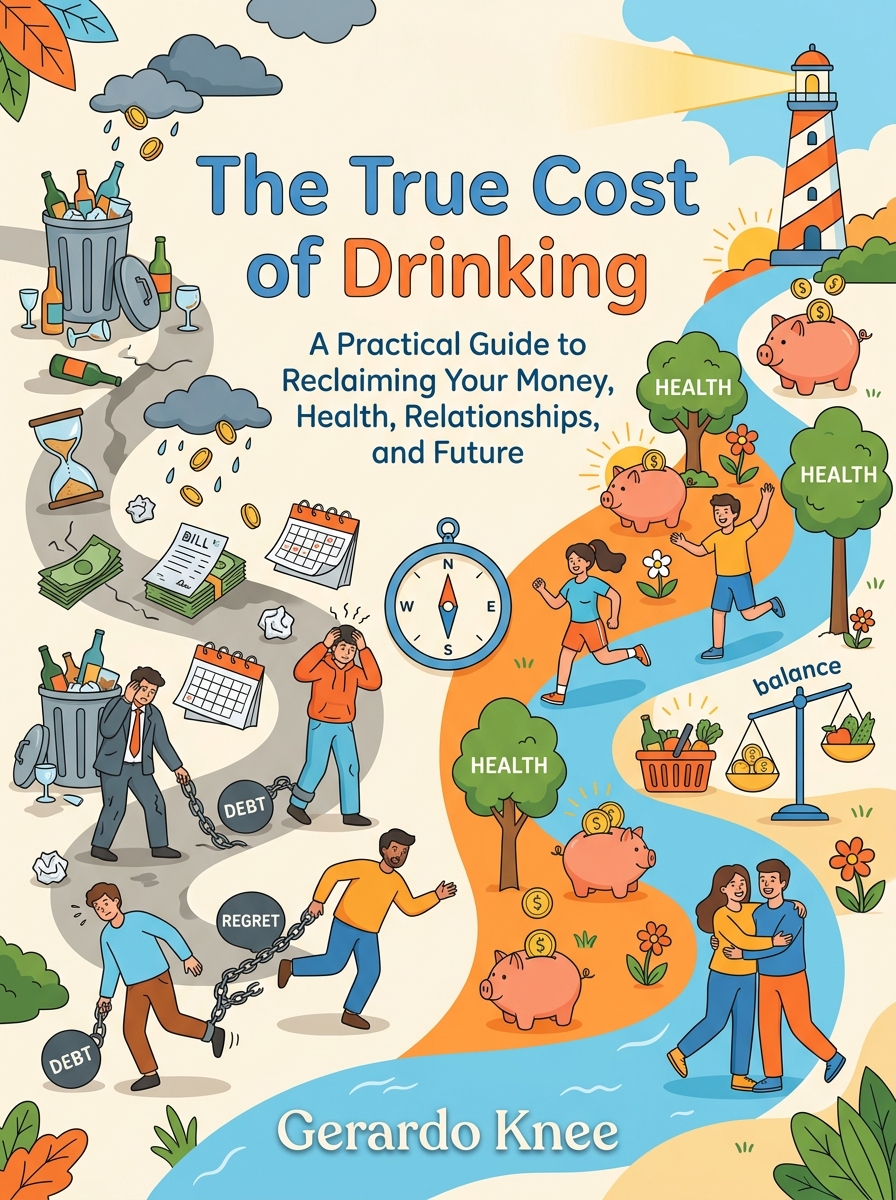
The first cost of drinking is easy to identify because it appears on a receipt. It may be a bottle of wine bought on the way home, several drinks at a restaurant, a case ordered for the weekend, or a delivery fee attached to an evening you had not planned to spend money on. Because each purchase can seem ordinary, the total often remains invisible. The expense does not arrive as one dramatic bill; it leaks out in small, repeated transactions that become part of the background noise of daily life.
Suppose you spend $18 on drinks three evenings each week and $60 on a larger weekend purchase. That is $114 a week, or $5,928 over a year. If the pattern includes a restaurant tab, transportation, and a convenience-store stop for food, the weekly total might be closer to $160, producing an annual cost of $8,320. Neither figure includes a single unusual night. It is simply what repetition does when an expense is treated as routine.
The direct cost is the amount paid specifically to obtain alcohol: purchases at stores, bars, restaurants, clubs, hotels, and delivery services. It also includes related spending that exists because drinking is taking place, such as mixers, ice, cigarettes, late-night meals, rideshares, and extra tips. You may not mentally place these items in the “alcohol” category, but your bank account experiences them as part of the same event.
This distinction matters because vague concern rarely changes behavior. A statement such as “I spend too much when I drink” may be true, but it does not give you a number you can examine. A number is more useful. It turns an uncomfortable feeling into information, and information gives you something to work with.
The second layer is indirect cost: money lost because drinking affects what happens afterward. A missed shift, a late arrival, reduced concentration, or a day spent recovering can affect income even when no money changes hands that morning. For a salaried professional, the loss may appear as diminished performance, delayed work, or a reputation for unreliability rather than a deduction on a paycheck. For someone paid hourly or through commissions, the impact may be immediate.
Drinking can also create repair bills. A damaged phone, broken glasses, stained clothing, ruined furniture, or a vehicle accident may follow a night that began with an ordinary purchase. So can a forgotten cancellation, an overdraft fee, a missed flight, or an urgent replacement bought at a premium. Legal costs belong in the same category when alcohol contributes to a charge, a court appearance, a fine, increased insurance premiums, or the loss of a license. These consequences are not inevitable, but a realistic assessment must make room for them.
Healthcare costs can be equally difficult to see. They may include appointments, testing, medication, emergency treatment, therapy, or higher insurance expenses. Alcohol can also worsen existing conditions, interfere with sleep, and make other health problems harder to manage. You should not attempt to diagnose yourself from a financial worksheet, but you can record the money you have paid for care that you believe is connected to your drinking, while discussing medical concerns with a qualified professional.
Then there is opportunity cost: the value of what your money, time, energy, and attention could have supported instead. Every dollar spent repeatedly on alcohol is a dollar unavailable for debt reduction, savings, travel, education, housing, or an emergency fund. Every morning spent recovering is time that cannot be used for exercise, meaningful work, family, or rest. Opportunity cost is not a moral judgment; it is the economic reality of choosing one use for limited resources over another.
Begin with a seven-day record, not a promise and not a guess. Look at bank and credit-card statements, digital receipts, delivery histories, cash withdrawals, and loyalty-app records. Record the alcohol itself, then add the associated transportation, food, tobacco, entertainment, and service charges. If you paid cash and cannot remember the exact amount, use your best estimate and mark it as an estimate; imperfect honesty is more useful than false precision.
Your weekly calculation can be written in one line: direct alcohol purchases, plus drinking-related spending, plus immediate consequences, plus the value of income or work lost. Imagine the totals are $95 for alcohol, $42 for food and rides, $20 for fees and impulse purchases, and $80 in lost work or recovery-related costs. Your weekly cost is not $95. It is $237, which becomes $12,324 when multiplied by fifty-two weeks.
The annual figure deserves a small adjustment. Some weeks are more expensive than others, and holidays, vacations, celebrations, and stressful periods can change the pattern. You can calculate a baseline by multiplying an ordinary week by fifty-two, then add known annual expenses such as medical bills, insurance increases, repairs, fines, or travel disruptions. If drinking is heavier during particular months, create separate estimates for a typical month and a high-cost month rather than forcing every week into one average.
Use a conservative approach when you are uncertain. Do not inflate the number to frighten yourself, and do not minimize it to make the result easier to tolerate. A useful worksheet might have four columns labeled “what I paid,” “what happened because I drank,” “what it cost,” and “what evidence supports this estimate.” The purpose is not to build a case against yourself. It is to see the full transaction.
As you review the result, circle recurring costs rather than focusing only on dramatic incidents. A single $400 repair is important, but so is the $12 delivery fee that appears three times every week. Recurring expenses are powerful because they hide in plain sight. Once they are multiplied across months and years, their weight becomes impossible to dismiss.