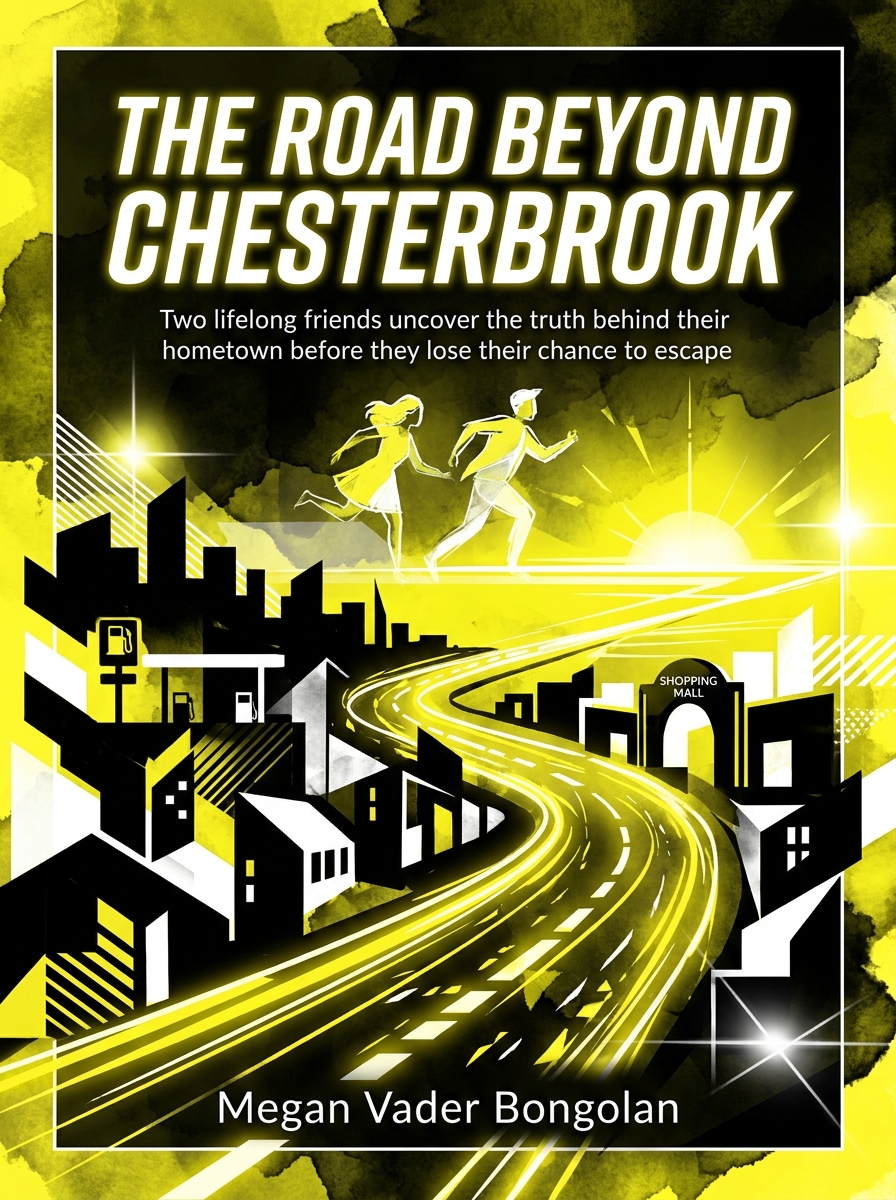
The gas pump clicked off before Ava Roslyn Clark had finished deciding whether to leave Chesterbrook forever.
She sat behind the wheel of her dusty blue Subaru, one hand resting on the gearshift, while the other tightened around the folded map in her lap. Outside, Charlie’s Pike flickered beneath a bruised evening sky, its red-and-yellow sign buzzing like an insect trapped in glass. The single gas station in town had not changed in seventeen years—not the cracked concrete, not the warped awning, not the faded advertisement for cherry slushies taped crookedly beside the register.
Ava looked through the windshield at the road beyond the station. Route 41 stretched west toward the highway, toward Chicago, toward every place she and JD had named in whispers and circled in library books. Denver. Seattle. New York. Anywhere with buildings taller than the water tower and secrets that belonged to someone else.
“Still thinking too hard?” JD asked.
He stood beside the passenger door with his hands in the pockets of his black jacket, his dark hair wind-tossed and his grin unrepentant. He had always looked as if he had just escaped from somewhere, even when he was the one arriving late. At twenty-four, he carried himself with the loose confidence of a man who believed every locked door was an invitation.
Ava lowered the map. “Still pretending you don’t think at all?”
“That’s my gift.”
“You have several. None of them useful.”
JD opened the door and dropped into the passenger seat. The smell of cold air, motor oil, and peppermint gum followed him inside. “You missed me.”
“I missed having someone to blame.”
“Same thing.”
She tried not to smile. She failed.
They had met at seven beside the creek behind Chesterbrook Elementary, when JD had stolen her red crayon and Ava had broken his nose with a lunchbox. Since then, she had planned every escape down to the last dollar, while JD had trusted momentum to carry him clear of town. Somehow, they had always moved in the same direction.
*
Charlie’s Pike hummed around them. A refrigerator rattled behind the counter, the pumps clicked and sighed, and somewhere near the highway a truck groaned through its gears. Through the front windows, Chesterbrook unfolded in familiar pieces: the brick diner with its blue neon spoon, the narrow storefronts along Main Street, and the distant glow of Parker’s Street Outlet Mall, where people from three counties came to buy discounted shoes and pretend the town was thriving.
“It looks smaller,” JD said.
“It is smaller.”
“Buildings don’t shrink.”
“Dreams do.”
He turned toward her, his amusement thinning. “That’s a cheerful thing to say on departure day.”
Ava folded the map and slid it into the glove compartment. Tomorrow morning, she and JD would drive north, sell their old furniture, and follow the interstate until Chesterbrook disappeared in the rearview mirror. She had accepted a position at a law office in Milwaukee. JD had a job waiting with a construction crew outside Madison, though he kept calling it temporary, as if refusing to name the future might stop it from demanding anything.
For years, the two of them had met at Charlie’s Pike on the first Friday of every month, putting ten dollars each into a coffee tin hidden beneath the pay phone. The tin had become an envelope, the envelope a bank account, and the bank account the key to the battered Subaru. Their plan had survived high school, dead-end jobs, Ava’s mother’s illness, and JD’s father disappearing without leaving an address.
Yet tonight, with the town gathered in the windows and shadows, leaving felt less like winning than trespassing.
The cashier, Mr. Pike’s grandson, watched them from behind the register. His name was Connor, though Ava remembered him as the boy who had refused to speak at his own eighth-grade birthday party. He lifted two fingers in greeting, then glanced toward the pay phone.
Ava noticed. “What?”
Connor looked away. “Nothing.”
JD pushed open the door. “Come on. I want to see whether our fortune is still under there.”
*
The pay phone hung on the station’s eastern wall beneath a plastic hood clouded with age. Its cord had been cut years ago, but no one had removed the phone. Chesterbrook was good at leaving things in place after their usefulness had ended.
JD crouched and reached beneath the metal shelf. “Still filthy.”
“You’re the one touching it.”
“I’m braver than you.”
“You once screamed because a moth landed on your shoulder.”
“That moth had criminal intent.”
Ava laughed, and for a breath the old ease returned. She could see them at thirteen, knees scraped and palms black with dust, hiding their savings beneath this same phone while rain hammered the awning. At sixteen, they had kissed here once—not because either of them had planned it, but because a storm had trapped them between the soda machine and the ice freezer. They had never discussed the kiss. They had simply gone on being Ava and JD, as if silence were a bridge strong enough to cross anything.
JD pulled out a flat tin covered in rust. “Empty.”
Ava crouched beside him. Inside lay a few pennies, a dead moth, and a strip of blue paper torn from a notebook. Her name was written across it in black ink.
Not Ava. Avalee.
The name struck with the force of a slammed door.
She took the paper from the tin. The handwriting leaned sharply to the right, the letters cramped and deliberate.
DON’T TRUST ANYONE WHO REMEMBERS THE SUMMER OF 2004.
For a moment, the station noise fell away. The pumps stopped clicking. The refrigerator ceased its rattling. Even JD’s breathing seemed to pull back into the walls.
“What does it say?” he asked.
Ava turned the paper over. Nothing.
“Who wrote it?”
“I don’t know.”
“Why is your full name on it?”