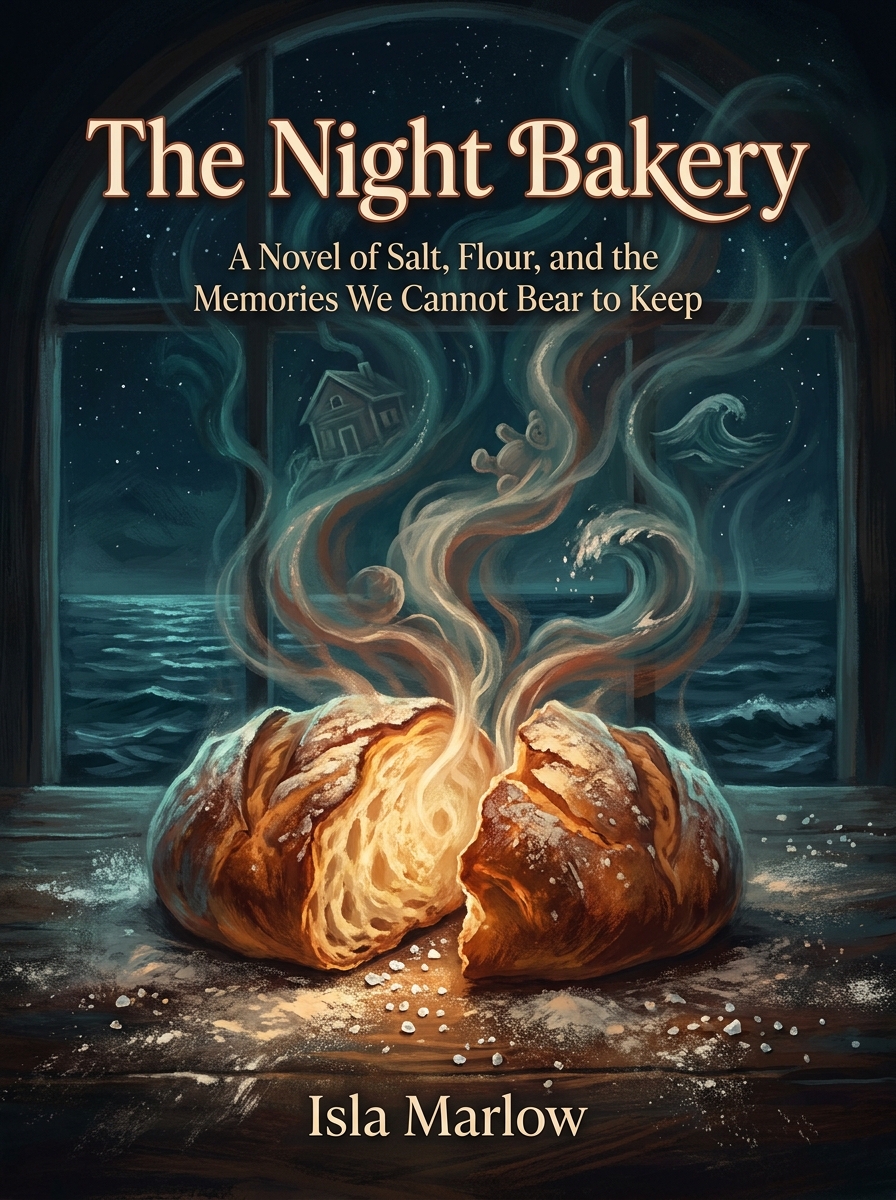
The dough fought her the way it always did at the start, stubborn and cold, clinging to the heels of her hands. Odalys Venn pressed down, folded, turned, pressed again, and felt the moment arrive when the resistance gave way and the whole mass softened into something alive. Behind her the great brick oven breathed its amber heat across the flagstones. Outside, beyond the salt-fogged window, the harbor lights of Marrow Point trembled on black water, and the clock above the flour bins said ten past twelve.
She had unlocked the door at midnight, as she did every night, and left the sign turned to its single word: OPEN. There was no other sign. In forty years no one in town had needed to be told what the bakery was for.
The bell rang before she'd finished shaping the first loaves. Teodor Brask came in sideways, the way he did everything, shoulders hunched against a wind that had stopped blowing hours ago. He was eighty if he was a day, his hands knotted from decades of net and rope, his coat still smelling of diesel and herring. He lowered himself onto the stool nearest the oven without a word and held his palms to the heat.
"Cold one," he said finally.
"It's always a cold one, Teodor," Odalys said. "You say it every time."
"Do I?" He almost smiled. "Forgetful old fool."
She said nothing to that. She only wiped her hands on her apron and went to the cooling rack, where a single loaf waited, round and dark-crusted, split across the top like a mouth about to speak. She had baked it an hour before he arrived, without being told it was his. The bread always knew. It was the one thing about her work she had never learned to explain, even to herself.
The rules of the bakery had never been written down, and she had never needed to say them aloud. One loaf, for one person, for one night. One memory, no more, returned whole and unbidden. And no questions about where the memory came from or how the flour held it, because Odalys had no answers, and because she had learned long ago that people could bear almost anything except being asked to explain their own sorrow to a stranger.
She set the loaf on a plain white plate and slid it across the worn wooden counter. Teodor looked at it for a long moment, the way a man looks at a letter he is afraid to open. Then he tore off the heel, and the crust cracked like ice breaking on a pond, and the smell rose between them, warm yeast and honey and something underneath that she could never name, something like rain on a roof you once slept beneath.
He chewed slowly. Swallowed. His eyes went somewhere far past the oven, past the window, past the harbor and the dark and forty years of fog.
"Oh," he said. It came out soft and startled, the sound of a man stepping on a stair that wasn't there. "Oh, she was in the kitchen. Marit. She was in her high chair, and I was doing the dishes, and I had my back to her, and she said—" His voice broke clean in half. "She said boat. Not papa. Boat. Because I was always going on about the boat."
The tears came all at once, running into the creases of his face and dripping from his jaw onto the counter. But he was laughing too, a wet, cracked, helpless laugh, one hand pressed flat against his chest as if to keep something from escaping. "Boat," he whispered. "My God, she was so proud of herself. She banged the tray with her spoon. She looked right at me, Odalys, and she banged the tray."
Odalys stood very still and let the moment be his. This was the part she could never prepare for, no matter how many nights she watched it happen. A memory returned was not a gentle thing. It arrived with its full weight, the joy and the loss braided so tightly together that you could not pull one strand without the other. Teodor's daughter had moved to a city three hundred miles away and called at Christmas. The word had been gone for fifty years, and now it was back, and so was every year since.
"Thank you," he said at last, wiping his face with a sleeve. He ate the rest of the loaf in silence, crumb by careful crumb, and when he stood, he seemed both lighter and older. He pressed three coins onto the counter, the price it had always been, and paused at the door. "Do you ever have one yourself?" he asked. "A loaf, I mean. For you."
"I'm not hungry," Odalys said.
He nodded, as though that were an answer, and the bell rang behind him, and the night swallowed his coat.
She cleared the plate and brushed the crumbs into her palm. Then, as she did every night, she glanced at the narrow door at the back of the bakery, the one beside the flour room, painted the color of old bone, which she kept locked and never opened. Her hand drifted to the key on its cord beneath her collar. The metal was warm from her skin. She let it go.
The hours turned over slowly. A woman came at one and left at half past, quiet, her wedding ring clutched in a fist. A young man came at two, ate his loaf standing, and walked out grinning at nothing. Odalys kneaded and shaped and baked, and the amber dark held her like a cupped hand, and the sea breathed against the pilings below.
At seven minutes past three, the bell rang.
It rang wrong somehow, a thin, uncertain note, as though whoever had pushed the door had hesitated halfway. Odalys looked up with flour to her elbows, and the cold came in before the stranger did, a breath of brine that cut through the oven's warmth and lifted the hair on her arms.
A girl stood on the threshold. Seventeen, perhaps, maybe less. Barefoot. Her dress clung to her in dark, heavy folds, and seawater ran from her hair and sleeves and fingertips, pooling on the flagstones in a spreading black stain. She was shaking, but her eyes were steady, fixed on Odalys with a terrible, quiet purpose.
Odalys knew every face in Marrow Point. She had known them for forty years.
She had never seen this one.