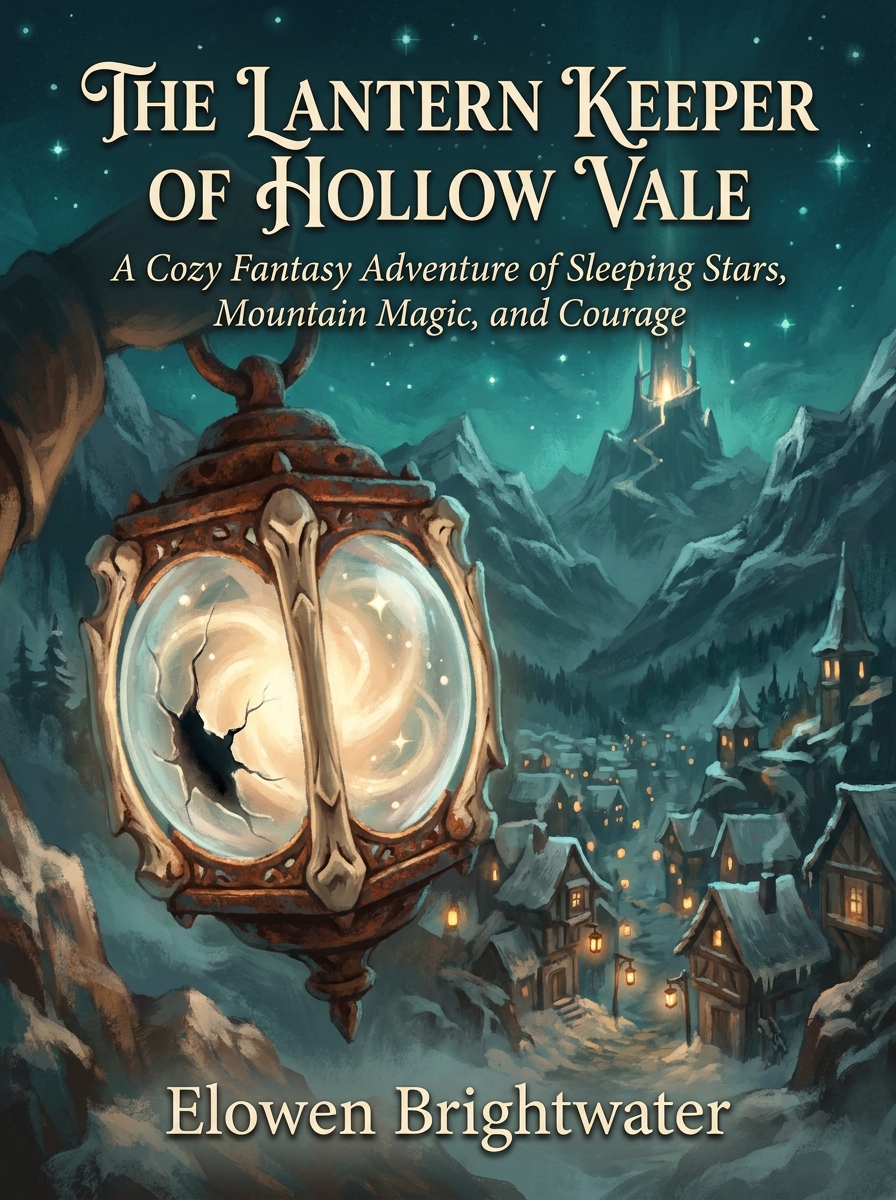
By the time Elianor Vey reached the roofline above the cooper’s shop, the first snow had begun to fall.
It came softly, no bigger than moth wings, settling on the crooked tiles and the shoulders of chimneys. Below her, Hollow Vale gathered itself for evening: smoke curled from stovepipes, shutters banged closed, and the bakery windows glowed the color of honey. Somewhere near the square, a baby wailed, a dog answered, and old Master Pell shouted that someone had stolen his turnips.
“Your turnips are in your cellar!” called a woman from the lane.
“They were in my cellar!” Master Pell shouted back.
Elianor grinned and hooked her brass pole over one shoulder. At seventeen, she knew every rooftop in the village better than most people knew their own floors. She knew which tiles wobbled, which gutters iced first, and which chimney bricks warmed her fingers through her gloves. Her boots found the narrow ridge without looking.
She carried the evening’s tools in a canvas satchel: a stoppered flask of lamp oil, a wick trimmer, a twist of rags, and her mother’s gloves. The gloves had once been thick brown leather, but years of weather had softened them until they folded like old leaves. One thumb was patched with blue thread. Elianor had sewn it herself, though the patch leaned crookedly to the left.
At the roof’s peak, she paused to look over Hollow Vale.
The village clung to the mountain in a bowl of dark pines and gray stone, its houses stacked along winding streets as if they had tumbled downhill and decided to stay. Lantern posts rose at every crossing. More lanterns hung from bridges, eaves, and the iron arms of the bell tower, waiting for her hand.
She lifted the brass pole.
The lantern above the cooper’s shop opened with a soft click. Inside, the star woke.
Not all the way. Never all the way. A sleeping star was no larger than a plum, folded into itself like a spark cupped in a fist. When Elianor touched the pole’s silver hook to the wick, the little light stirred, shivering gold beneath its glass. The lantern brightened, and warmth spilled across the snow.
“Good evening, little one,” she murmured.
The star answered with a faint chiming sound, like a spoon touching the rim of a teacup.
Everyone in Hollow Vale knew the lanterns held sleeping stars. Children were taught the old story before they could read: long ago, the sky had shed its brightest stars into the mountains, and the first lantern keepers had gathered them before they froze. Since then, each village lantern had sheltered one, lending its glow to homes below.
Most people treated the tale as kindly nonsense. Bakers polished their windows beneath star-lamps. Shepherds tied ribbons to the posts. On winter nights, children pressed their noses to the glass and tried to count the sparks turning inside.
Elianor knew better.
She had seen a star blink.
She had seen one curl tighter when thunder rolled over the peaks, and once, when she was six, she had watched a blue one stretch a thin ray of light toward the moon. Her mother had caught her standing on a flour crate beneath it and laughed so hard she had to sit down.
“Stars are not candles, Leni,” her mother had said. “You must never treat them like candles.”
“What are they, then?”
Her mother had looked toward the dark mountain beyond the village. “Promises.”
That was the last winter before she vanished.
Elianor slid from the cooper’s roof to the adjoining awning, where three hens clucked indignantly beneath a tarp. She apologized to them, crossed the slanted boards, and dropped onto the balcony of the tailor’s house. Mrs. Orra opened her window as Elianor passed.
“Mind the frost, girl!”
“I am minding it.”
“You mind it with your feet, not your head.”
“My head is busy keeping the rest of me alive.”
Mrs. Orra snorted and pushed a warm bun through the window. Elianor caught it one-handed.
“For the road,” the tailor said.
“For the road to the next lantern?”
“For the road to supper, if you don’t fall and break your neck.”
Elianor tucked the bun into her satchel, where it warmed the oil flask. That was Hollow Vale: no one let you cross a roof without shouting advice, and no one shouted advice without offering food.
The lane below filled as dusk deepened. The miller’s twins chased one another between the posts until their father caught them by their collars. At the square, the butcher carried out a tray of sausages, while the apothecary hung sprigs of wintergreen over her door. From the inn came fiddles and the clatter of cups.
Elianor climbed higher, toward the bell tower.
Her mother had been the village’s lamplighter before her. Mara Vey had known the names of every star, though she had never explained how. She could tell a restless star from a frightened one, could hear when a wick was choking, could mend a lantern hinge by touch alone.
On the night Mara disappeared, the longest night was three weeks away.
She had gone to the north ridge to tend the lanterns along the old path. Snow had swallowed the trail before dawn. Searchers found her brass pole wedged between two stones and one glove hanging from a pine branch.
They never found Mara.
Elianor had been nine. For eight years, she had carried the unanswered shape of that night inside her, like a stone too large to swallow and too familiar to spit out. People spoke of her mother gently, then changed the subject. They said the mountain took what it was owed. They said some paths led farther than a person meant to go.
Elianor said nothing at all.
Above the bakery, the bell tower rose from the square, its timber sides black with age. The lantern hanging beneath the bell was the oldest in Hollow Vale, a round iron cage with panes of cloudy glass. It was usually the brightest, because the bakery’s ovens kept the air warm around it.