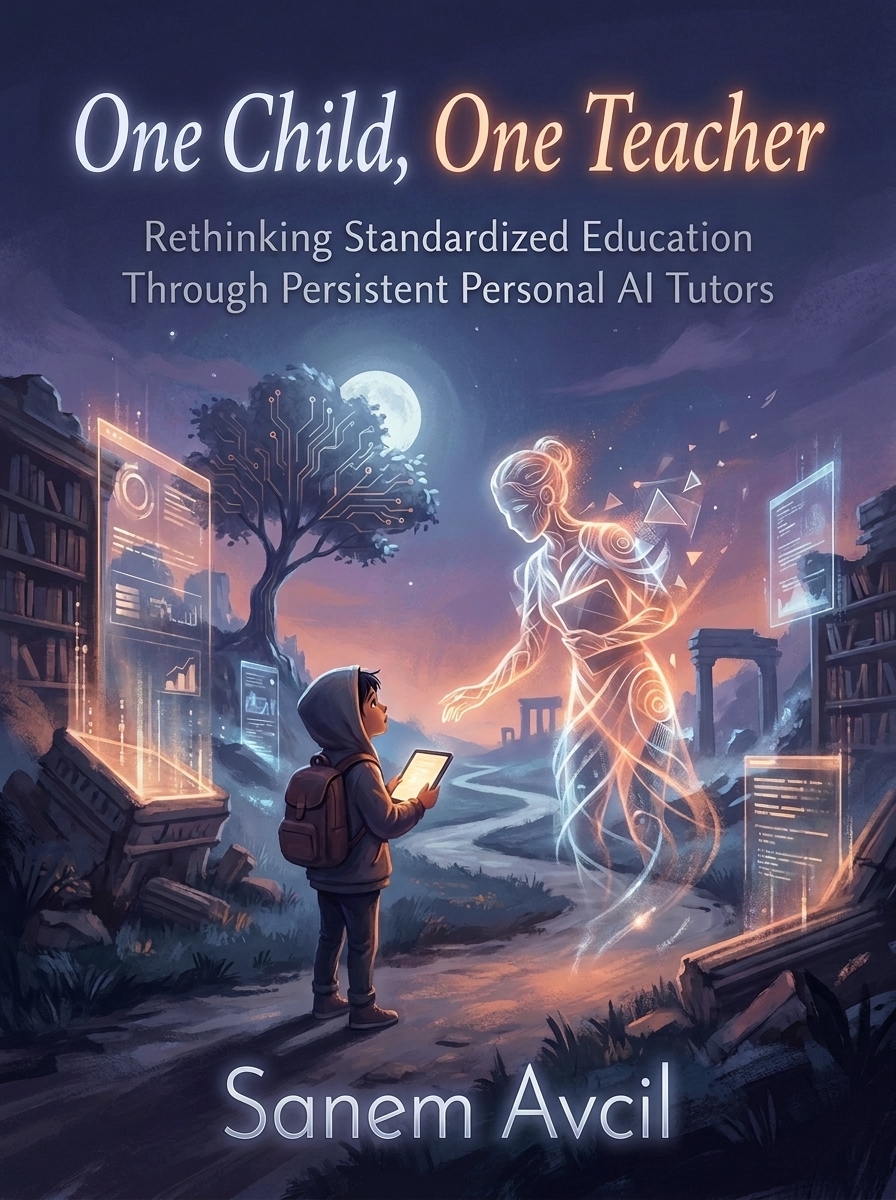
Imagine a learner beginning a school year with more than a timetable, a collection of textbooks, and a succession of teachers. Imagine that learner also has a trusted educational companion: a system that understands what has already been learned, remembers which explanations helped, notices where confusion began, and carries that knowledge forward into the next lesson, subject, and year. It does not replace the classroom or remove the teacher. Instead, it provides a continuous layer of attention around the learner, even when the adults and institutions responsible for instruction are divided by schedules, departments, and changing academic programs.
This is the central promise of One Child, One Teacher: a persistent personal AI tutor that accompanies a learner over time. Persistence is the essential idea. A conventional educational application may explain fractions during one session, mark a vocabulary exercise during another, or generate practice questions for an upcoming test. A persistent tutor would connect those moments, recognizing that difficulty with fractions may later affect algebra, physics, economics, or everyday reasoning, and that a child’s confidence can influence whether the child attempts the next challenge.
The distinction matters because education is not a sequence of unrelated transactions. Learning accumulates, but so do misunderstandings, anxieties, habits, interests, and hopes. A student who repeatedly memorizes procedures without understanding them may appear successful until a new context exposes the gap. A student who asks few questions in class may still be intensely curious, waiting for a setting in which uncertainty feels safe. The promise of a persistent tutor is to make those patterns visible and useful without reducing the learner to a score.
Most people have already encountered the first generation of AI learning tools. They can answer a question, summarize a passage, translate a sentence, produce practice problems, or offer a step-by-step explanation. Used responsibly, these capabilities can be valuable. Yet they are usually episodic: the learner arrives with a problem, receives a response, and leaves without creating a durable educational relationship.
Episodic support is shaped by the immediate prompt. If a student types, “How do I solve this equation?” the system may respond effectively, but it may not know whether the student has confused negative numbers for three weeks, whether the equation belongs to a larger unit on proportional reasoning, or whether the student is asking because the assignment is due in ten minutes. The answer can be correct while the learning remains fragile. Automated homework help often treats the visible question as the whole situation, when it may be only the latest sign of a deeper need.
A long-term tutor would approach the same moment differently. It might recognize that the student has previously succeeded when diagrams were used, struggled when several symbolic steps appeared at once, and improved after explaining an idea aloud. It could ask a carefully chosen question, offer a visual representation, pause before giving the next hint, and record what this interaction suggests about future instruction. The goal would not be to complete the assignment as efficiently as possible. The goal would be to help the learner become more capable of completing the next assignment with less assistance.
This requires a change in the unit of design. Instead of building an AI for a subject, lesson, or application, we begin with the learner’s continuing development. Mathematics, literature, science, languages, history, and practical projects remain distinct domains, but the learner no longer experiences them as disconnected silos. The tutor can help reveal relationships among them while preserving the expertise and purpose of each discipline.
Continuity is difficult for schools because educational responsibility is distributed. A child may encounter one teacher for reading, another for mathematics, a specialist for language support, and a new group of adults after moving to another grade or school. Each teacher may care deeply and work skillfully, yet no individual can hold a complete, reliable history of every learner’s experiences. Important knowledge often survives only in scattered records, informal impressions, or the student’s own memory.
A persistent tutor could provide a living learning record, but that phrase must be understood carefully. The record should not be a permanent judgment that follows a child like a hidden transcript. It should be an evolving account of demonstrated understanding, current questions, preferred ways of engaging, unfinished goals, and evidence that can be reviewed and corrected. The learner and the responsible adults would need meaningful control over what is retained, what is shared, and what is allowed to fade.
Consider the difference between two transitions. In one, a new teacher receives a test score, a set of attendance records, and a brief comment that a student is “behind.” In the other, the teacher receives a clearer picture: the student reads complex material aloud with confidence, has difficulty organizing written responses, understands scientific ideas when they are connected to real systems, and has recently begun volunteering answers after successful small-group work. The second picture does not prescribe a destiny. It gives the teacher a more intelligent place from which to begin.
Persistence could also protect learning from the accidents of time. A child’s progress should not be erased because a school changes software, a teacher changes roles, or a family relocates. At the same time, continuity must never become surveillance. The educational value lies in remembering what helps a learner grow, not in collecting every interaction simply because technology makes collection possible.