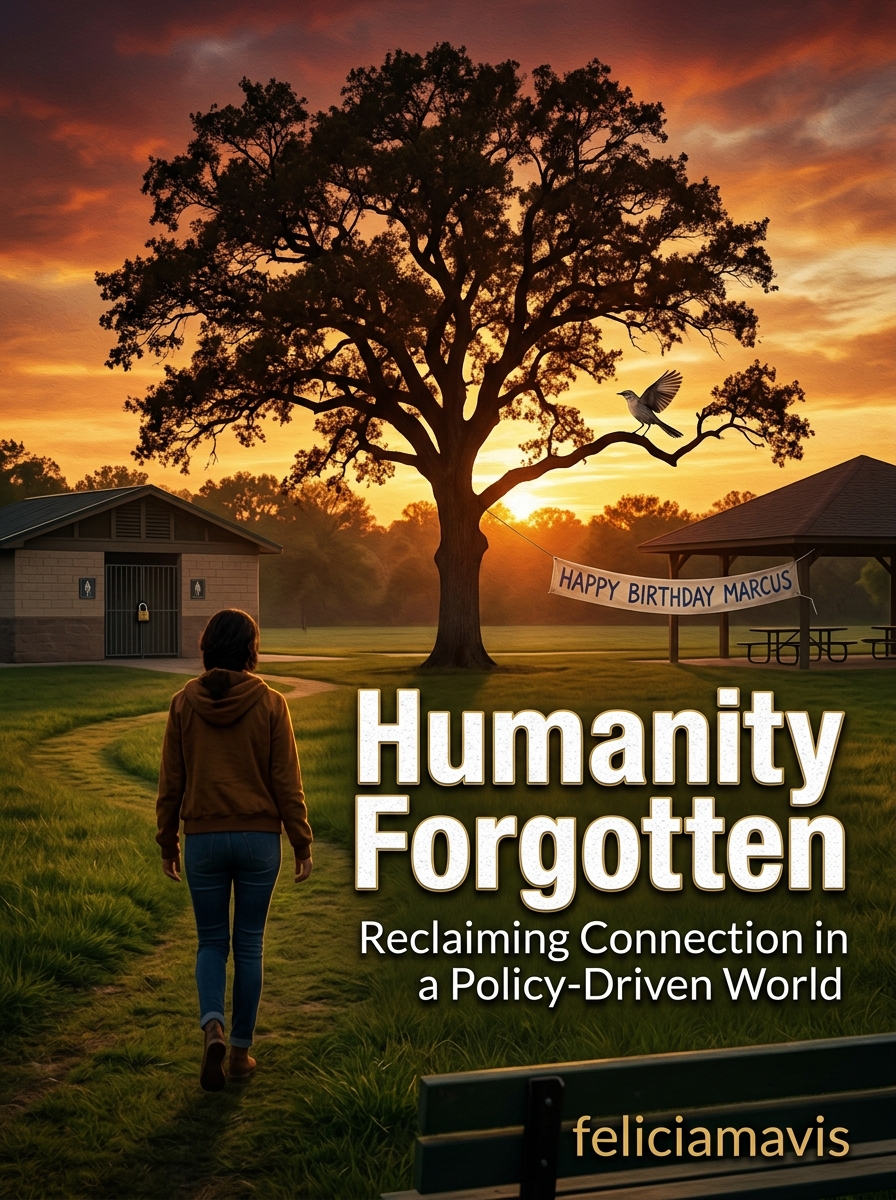
The dawn light spilled over Harmon Park like a soft promise, illuminating the dew-kissed grass and casting long shadows from the towering oak trees that lined the paths. Dale sat in his truck, windows down, savoring the cool morning air infused with the scent of eucalyptus and wet earth. The world was still asleep, cocooned in a blanket of silence, and for a moment, he allowed himself to linger in that tranquility. This was his favorite hour — the quiet hour before life stirred and complicated what was simple.
He could hear the faint rustle of leaves overhead, the occasional chirp of a distant bird, and the gentle hum of life just beginning to awaken. Dale had been a parks worker for nineteen years, and in that time, he had developed a rhythm to his mornings that felt as natural as breathing. He relished the routine — starting at the east entrance to check the gates, then looping around the perimeter, taking in the subtle changes that each day brought. Harmon Park, in particular, had a way of revealing itself in layers.
As he drove slowly along the winding path, he took note of the remnants of human activity left behind from the previous day. The main pavilion bore the marks of a birthday celebration; scattered ribbons danced in the breeze, and a deflated mylar balloon shaped like the number seven lay forlornly near the flower beds. The sweet, smoky scent of last night’s barbecue still lingered in the air, a ghostly reminder of laughter and joy that had filled this space hours before. It was as if the park held onto the essence of those moments, the invisible residue of happiness that settled into its very soil.
He chuckled softly at the sight of a handmade banner that sagged between two posts, announcing "HAPPY BIRTHDAY MARCUS" in bright, glittery letters. The colorful display was a testament to the lives that unfolded here, to the laughter that echoed among the trees. Dale had always believed that parks like this one existed as sanctuaries, places where people could momentarily escape the weight of the world and bask in the simple beauty of being alive. But as the years had passed, he had begun to feel that belief fraying at the edges.
Somewhere around his fifteenth year of service, he had noticed a shift within himself. The thrill of the job had dulled, the vivid colors of joy fading to a muted palette of responsibility and policy. The park was still breathtaking, but he had become a gatekeeper, a warden of rules that seemed to grow more convoluted with each passing season. With every new directive from the administration — no food vendors, no gatherings larger than ten, no restrooms open before nine — he had felt a little piece of that sanctuary slip away.
The mockingbird perched in the oak near the east entrance broke through his thoughts, its song ringing out like a clarion call. Dale smiled, recognizing the familiar melody that had become a part of his morning ritual. The mockingbird was a virtuoso, a collector of sounds, imitating everything from a blue jay to a car alarm, but it was the rising trill that always intrigued him the most. It was a question that lingered in the air, waiting for an answer that would never come. He found comfort in that bird’s freedom, in its ability to sing without hesitation, without the weight of policy or expectation.
As he wrapped up his rounds and made his way back toward the entrance, something caught his eye. A figure darted across the grass, moving with urgency yet cautious enough to slow down as she approached him. The young woman, perhaps in her early twenties, had an air of determination about her, but there was also a vulnerability in the way she carried herself. As she got closer, Dale could see the backpack slung over her shoulder, its straps pulled tight against her chest.
“I know it’s early,” she said, breathless and earnest. “But can you unlock the bathroom for me?”
Dale’s heart sank as he glanced at the locked restroom building. The policy had been crystal clear for the past three months: no restrooms open during morning hours. It didn’t matter that the park gates had opened at six; it didn’t matter that people were already here, existing in what was supposed to be public space. A faceless decision-maker had deemed it necessary for “liability reasons.”
“I can’t unlock this one,” he replied, the words feeling heavy on his tongue. He watched her face shift, a flicker of disappointment crossing her features, but it wasn’t a surprise. Dale noticed that her eyes, brown and steady, reflected a resignation that came from being met with denial too many times. She nodded slowly, turning her gaze away, and Dale felt a pang of regret settle in his chest.
But then, something shifted in him.
“I’ve got the truck,” he said, almost before he could think it through. “The nearest open bathroom is about four minutes from here at the community center on Fifth. I can give you a ride if you want.”
Her eyes widened, a spark of hope igniting as she turned back to him. “Really?”
“Come on,” he said with a grin, feeling a sense of liberation seep into his bones. “Before I think about it too much.”
The ride to the community center was quiet, punctuated only by the soft hum of the engine and the occasional chirp from the birds outside. Dale stole glances at her from the corner of his eye, taking in the way she clutched the straps of her backpack, as if it were a lifeline. She introduced herself as Daisy, and he mentioned his name was Dale, which elicited a small laugh from her. It was a good name for a parks worker, she said, and for a brief moment, the weight of the world outside their little bubble seemed to lift.
“I like Harmon Park because it’s quiet in the mornings,” she said, her voice softening as she spoke. “I’ve been listening for the mockingbird for weeks. He always starts around six.”
Dale nodded, intrigued. “You know his whole routine?”