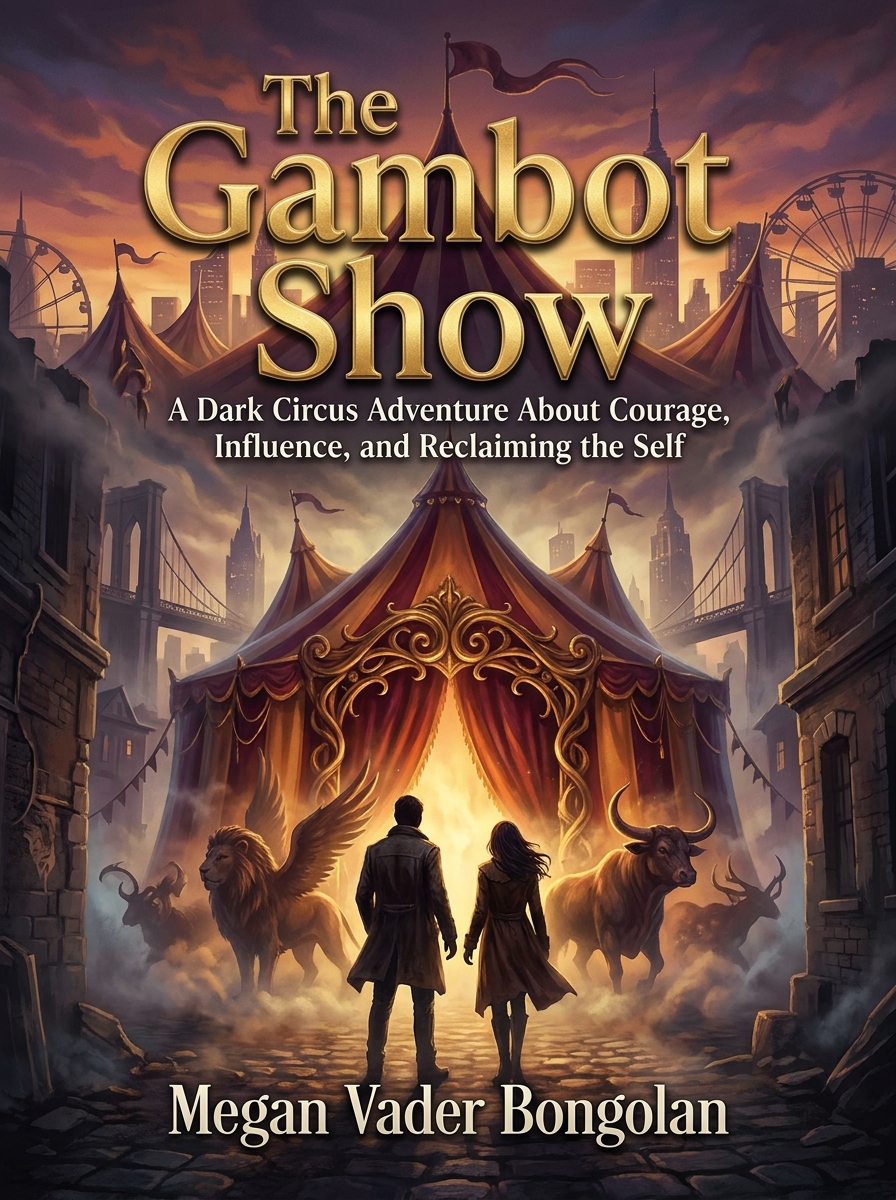
The street split open beneath Debrah’s boots with a sound like a giant tooth breaking.
She froze beside the shuttered laundromat, one hand gripping the strap of her canvas bag, the other raised against the rain that had begun needling down from the black October sky. A jagged line had appeared in the asphalt between two dented cars, thin as a knife cut at first, then widening with a groan that rolled beneath the buildings.
Ramison caught her arm.
“Don’t move.”
“I wasn’t planning to,” Debrah said.
The crack widened again.
A breath of furnace air rushed up from below, carrying the smell of hot oil, cinnamon, pepper, and something sweetly rotten. Beneath it came music—faint at first, then bright and brassy, a trumpet tumbling through a melody that seemed to laugh at its own madness.
The laundromat’s dead sign flickered above them.
WASH— WASH— WASH—
Then every bulb went dark.
For three seconds, New York held its breath.
A taxi hissed through a puddle at the end of the block. Somewhere above, a baby cried behind a lit apartment window. Steam rose from a manhole, twisting in the glow of a pharmacy sign. The city continued its restless life, unaware—or pretending to be unaware—that something beneath its streets had just opened its mouth.
Debrah leaned toward the split.
“Ramison,” she whispered, “is that music?”
“It is now.”
“That’s not an answer.”
“It’s the best one I have.”
The crack trembled. A strand of golden light appeared in its depths, no wider than a shoelace. It pulsed in time with the trumpet, and each pulse sent a vibration through Debrah’s soles. The rain around them began to hiss when it touched the edges of the broken asphalt.
Ramison pulled her backward. “We should call someone.”
“Who?”
“The police.”
“And tell them what? There’s a singing hole under Delancey Street?”
“Maybe don’t call it singing.”
“Then what do we call it?”
He looked at the widening darkness. His face, usually sharp with amusement, had gone pale beneath the copper streetlight. “A structural hazard.”
A sudden peal of laughter floated up from underground.
Not human laughter. Not exactly. It sounded like a crowd laughing together, thousands of voices joining at once, all delighted by a joke none of them had heard before.
The crack opened another inch.
From somewhere beneath the city, a voice called, “Step right up!”
Debrah and Ramison stared at each other.
A second voice cried, “The Gambot Show is waiting!”
Then a hand emerged from the split.
It was gloved in white, though the glove was stained with grease and soot. The fingers clawed against the asphalt, searching for purchase. The wrist followed, then an elbow, and finally a man dragged himself out of the opening on his stomach.
He wore a red tailcoat with gold piping, black trousers tucked into striped boots, and a hat crushed flat on one side. Rainwater streamed from his dark hair. His face was powdered white, but the powder had run in crooked trails, exposing gray skin beneath. A crescent of red paint curved from the corner of his mouth to his cheek.
He rolled onto his back and stared up at Debrah.
“Ladies and gentlemen,” he rasped, “you are just in time for the grand arrival.”
Ramison stepped between them. “Who are you?”
The man sat up too quickly. His neck snapped straight with an audible click.
“I am the one who was lost,” he said. “I am the one who performed. I am the one who must return before the curtain falls.”
“You need an ambulance,” Debrah said.
The man turned his head toward her. His pupils were enormous, swallowing nearly all the color in his eyes.
“No ambulance,” he said. “No sirens. Sirens upset the animals.”
“What animals?” Ramison demanded.
The performer smiled. “The holy ones.”
Another tremor ran through the pavement. A woman across the street dropped her umbrella. She stared at the crack, but instead of screaming, she began humming the trumpet melody.
Debrah looked toward her. “Ma’am?”
The woman lifted her head. Her lips shaped the tune faster now. She tilted her umbrella like a parasol and spun once on the sidewalk, rain splattering her red coat.
Ramison swore under his breath.
The performer gave a pleased little clap. “There it is. The first dance.”
“Stop that,” Debrah said.
The woman continued spinning. A delivery cyclist slowed to watch her. He began tapping his fingers against his handlebars. The taxi driver at the end of the block leaned on his horn in three sharp blasts, matching the rhythm.
Music was spreading through the street.
Debrah crouched beside the performer. “What is this place?”
He looked past her, beyond the rain and the trembling buildings, as though he could see a world hidden under the pavement.
“Carnival Adenturedom,” he whispered. “Where the hungry are fed, the lonely are applauded, and every soul receives a ticket.”
Ramison grabbed the man by the collar and hauled him upright. “You came out of that hole. You’re going back in.”
The performer’s smile vanished.
“You must not let it close.”
The crack gave a violent shudder.
Its edges began pulling together.
The golden light below flared, and the music grew louder. Trumpets, drums, fiddles, and the deep booming pulse of something enormous filled the block. The air became hot enough to sting Debrah’s eyes. A smell of fried dough rolled over them, rich and irresistible, followed by the sharper scent of peppered peanuts and potatoes baked beneath a crust.
Her stomach clenched.
The performer seized her wrist.
“Come,” he said. “If you remain here, the show will find another entrance.”
Ramison slapped the man’s hand away. “We’re not going anywhere with you.”
A crack appeared in the side of the laundromat wall.
Then another split the curb.
The golden light began leaking through the city in thin, glowing seams.
A parked car shuddered. Its headlights came on. Both beams swung toward the crack as if the vehicle itself had turned to watch.