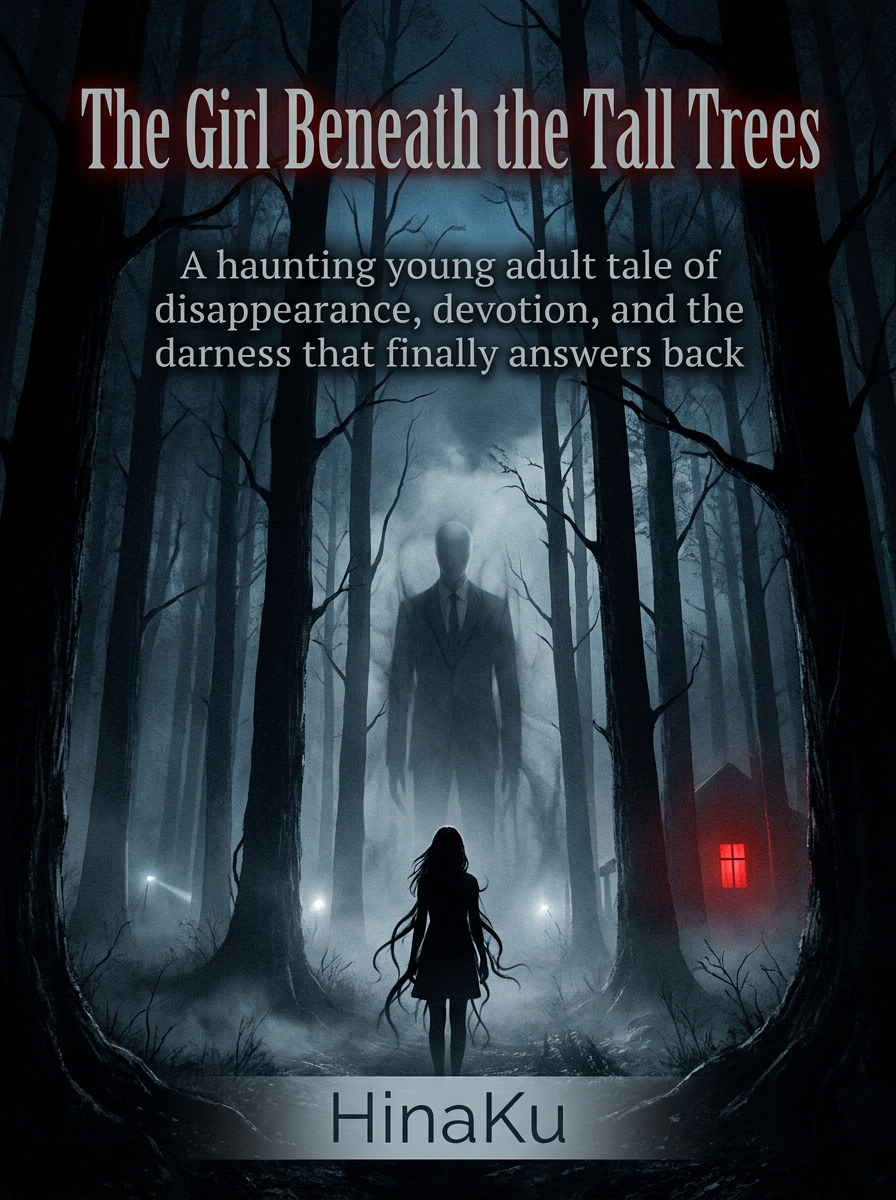
The message was tucked beneath Jade Mercer’s dinner plate.
She found it when Eli reached across the table for the salt and their mother began talking about the missing dog from the house on Willow Street. A thin curl of bark rested against the white ceramic, dark with rain and marked in black ink.
COME ALONE.
Jade stared at the words until the letters blurred.
“Jade?” her mother said.
The bark scraped beneath Jade’s thumb. It was damp, though the kitchen was warm and dry, and a smell rose from it—wet earth, pine sap, and something bitter beneath both, like smoke from a fire that had gone out hours ago.
“What?” Jade asked.
“You’re not listening.”
“I am.”
Eli snorted. “You’re never listening.”
He was twenty-one and had perfected the art of speaking as if every sentence were a verdict. He sat across from her in his work jacket, the sleeves rolled to his elbows, a pale scar cutting through one eyebrow. Rain ticked against the windows behind him. Beyond the glass, the town had disappeared into a curtain of gray.
Their mother pushed a strand of silver-streaked hair behind her ear. “I said Mrs. Vale found the dog’s collar near Blackwood Road.”
Jade folded the bark beneath her plate. “So?”
“So?” Eli repeated. “That’s all you have to say?”
“It’s a dog.”
“It was a dog,” he said.
The fork in their mother’s hand struck the rim of her bowl. She looked down at the stew as though something inside it had spoken. For three months, every conversation in the Mercer house eventually bent toward loss. The empty room upstairs. The unanswered phone calls. The last red scarf found in the trees.
Her father’s name was never said at dinner anymore.
Jade pressed her knees against the underside of the table. “People lose things.”
“Not in Blackwood,” Eli said.
“You don’t know that.”
“I know more than you do.”
“That’s convenient.”
“Jade.” Their mother’s voice sharpened, but only for a second. Then it softened into exhaustion. “Please don’t start.”
Jade almost laughed. Don’t start. As if she had been the one who started the silence, the locked doors, the daily texts asking where she was and when she would be home. As if Eli had not begun driving her to school the week after Dad disappeared, waiting outside every classroom until the bell rang. As if their mother had not taken the batteries from Jade’s old radio because she thought the static sounded like voices.
Jade lifted her spoon. The stew had gone cold.
“I’m going upstairs,” she said.
“You’ve barely eaten,” her mother replied.
“I’m not hungry.”
Eli leaned back in his chair. “You’re not going anywhere.”
Jade looked at him. “I’m going upstairs.”
“You heard me.”
Something hot and bright moved behind her ribs. “You’re not my father.”
The room went still.
Rain hissed against the windows. Somewhere beneath the floorboards, the furnace groaned awake.
Eli’s face changed first—not anger, exactly, but the sudden closing of a door. Their mother lowered her eyes. Jade saw the hurt move across her face and hated herself for noticing.
Then the kitchen light flickered.
Once.
Twice.
The third time, it went out.
The house sank into darkness.
Their mother gasped. Eli shoved his chair back so quickly it toppled behind him. Jade heard him curse, heard the sharp scrape of his boots against the floor as he crossed toward the counter where the flashlight lived.
“Stay where you are,” he said.
A pale glow appeared in his hand.
Jade looked down at her plate.
The bark was gone.
For one breath, she thought she had imagined it. Then she saw something dark beneath the edge of the tablecloth. A narrow strip of wood had fallen to the floor beside her chair.
COME ALONE.
The ink had changed.
A second line had appeared beneath the first.
BEFORE THE TREES COME FOR YOU.
Jade’s mouth went dry.
“Mom,” she whispered.
“What?”
Nothing. She bent beneath the table and snatched up the bark before Eli could turn around. Its wet edge cut her palm.
Outside, beyond the rain-streaked window, something stood at the end of the backyard.
It was too tall to be a person.
Jade froze.
The figure was half-hidden by the darkness, a black shape between the maple trees. Its shoulders rose above the fence. Its head was smooth and pale—or perhaps there was no head at all, only the suggestion of a face where the rain seemed to bend around it.
A flash of lightning split the sky.
The yard was empty.
“Jade?” Eli called.
She closed her hand around the bark. “I’m fine.”
He turned, flashlight beam sweeping over her. “Where are you going?”
“Nowhere.”
But while Eli checked the fuse box and their mother searched for candles, Jade slipped the bark into the pocket of her hoodie. She waited until the kitchen filled with the sound of drawers opening, until Eli’s attention shifted toward the basement door.
Then she went upstairs.
Her room smelled of dust and lavender detergent. The storm had made the windows tremble in their frames, and every few seconds the glass flashed white with distant lightning. Jade grabbed her boots from beneath the bed, pulled on her raincoat, and stood in the center of the room listening to the house.
Her mother was crying downstairs.
Eli was saying, “I’ll look for her.”
Jade’s hand tightened around the doorknob.
She should go back. She should tell them about the bark, about the figure in the yard. She should call someone—though she didn’t know who. The police had already searched Blackwood twice for her father. Volunteers had dragged the creek with ropes and flashlights. The sheriff had stood in their living room and promised there was no evidence of foul play.
But a week later, a hiker found Dad’s watch on a branch twelve feet above the ground.
No one had explained that.
The town had explanations for everything else. Bears. Floodwater. Drunks. Teenagers running away. The Blackwood itself was never mentioned unless someone had to say the word.